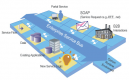
Online or onsite, instructor-led live Service-Oriented Architecture (SOA) training courses demonstrate through interactive discussion and hands-on practice the mechanics of SOA and the added value of using service contracts as part of your development process for government.
SOA training is available as "online live training" or "onsite live training". Online live training (also known as "remote live training") is conducted via an interactive, remote desktop. Onsite live training can be conducted locally on customer premises in Michigan or in Govtra corporate training centers in Michigan.
Govtra -- Your Local Training Provider for government
Detroit, MI - Renaissance Center
400 Renaissance Center, Detroit, United States, 48243
The GM Renaissance Center is conveniently located in downtown Detroit and easily accessed by car via Interstates 75 or 94, with secure underground parking available on site. Travelers flying into Detroit Metropolitan Airport (DTW) can expect a 25–30 minute trip by taxi or rideshare via I‑94. Public transit is efficient: the Detroit People Mover stops directly at the Renaissance Center station, and DDOT routes 3 and 9 serve nearby Jefferson Avenue. Pedestrian skywalks provide safe indoor access from downtown hotels, parking garages, and the riverwalk.

Ann Arbor, MI – Regus - South State Commons I
2723 S State St, Ann Arbor, United States, 48104
Regus South State Commons I is conveniently located off I‑94 via Exit 177 (State Street), with easy access to downtown Ann Arbor and surrounding suburbs. The building offers free on-site surface parking for guests. From Detroit Metropolitan Airport (DTW), the venue can be reached in approximately 20–25 minutes by taxi or rideshare via I‑94 West. Local public transit service (TheRide) operates Route 24 along South State Street, with a stop within a short 2-minute walk of the building.
Grand Rapids, MI - Regus – Calder Plaza
250 Monroe Ave NW, Grand Rapids, United States, 49503
The venue sits centrally at 250 Monroe Avenue NW in downtown Grand Rapids, easily accessed by car via US‑131 or I‑196—with connections via Monroe or Ottawa exits—and offers shared underground and surface parking. From Gerald R. Ford International Airport, take I‑96 East then I‑196 West into the city; the drive is about 20 minutes. Public transit through Rapid bus routes stops near Monroe or Ottawa Avenue, just a short walk from the Regus entrance; the downtown area is pedestrian-friendly.
Lansing, MI - Regus - One Michigan Avenue
120 North Washington Square, Lansing, United States, 48933
The venue is located in the heart of Lansing’s central business district at 120 North Washington Square, easily accessible by car via I‑496 or US‑127 with convenient street parking and a nearby parking ramp. From Capital Region International Airport (LAN), the location is approximately a 12‑minute drive west via I‑96 and US‑127, with taxis and rideshares readily available. Public transit users can take CATA bus routes that stop just a block away on Washington or Grand Avenue, offering seamless access to the venue.
This course is designed for technical professionals who seek to learn OpenESB. It delves into the essential concepts necessary for a comprehensive understanding of service integration design and development. The curriculum covers standard specifications such as XML Schemas, WSDL, and BPEL, which are integral to OpenESB. This two-day course equips participants with the foundational knowledge required to grasp OpenESB principles and designs. For immediate operational expertise, additional training through OpenESB Training T02 is recommended for government and other sectors.
In this instructor-led, live training for government in [location], participants will learn how to connect various applications, data sources, and APIs as they build a sample routing application using Mule.
By the end of this training, participants will be able to:
- Design, build, and manage the connectivity between APIs, applications, and services.
- Manage interactions across legacy systems and custom applications.
- Integrate software as a service (SaaS) and on-premises software.
- Use Mule's design and development tools to design, test, and run Mule flows.
- Understand and support different messaging standards, including AMQP, JMS, and WMQ.
- Monitor, deploy, and configure applications with Mule Management Console (MMC).
The course is designed for government developers and web application professionals, aiming to provide a comprehensive understanding of the opportunities offered by the REST architectural pattern. This pattern facilitates efficient communication between websites and ensures alignment with public sector workflows, governance, and accountability.
The ED-SOA training for government emphasizes constructing and analyzing an architectural framework that expands on the SOA reference architecture. This approach utilizes services as event generators to signal issues, potential problems, opportunities, thresholds, or deviations.
This course is designed for IT architects, mid-level IT managers, and IT consultants.
Format of the Course
The current format consists entirely of lectures; however, the inclusion of tests may be considered to enhance the learning experience for government professionals.
This five-day course is designed to provide a comprehensive understanding of the principles and mechanics of Service Oriented Architecture (SOA). Participants will gain insights into the technical design of SOA-based architectures and explore how these designs can be applied to develop effective solutions for government and business challenges. The curriculum emphasizes the alignment of SOA with public sector workflows, governance, and accountability, ensuring that participants are well-equipped to implement and manage service-oriented solutions in their respective organizations.
This course has been developed for government managers and architects who are planning to implement or are currently implementing Service-Oriented Architecture (SOA) solutions. It provides an overview of the advantages and disadvantages of SOA, explaining when, why, and which aspects of SOA should be utilized.
Some of the questions this course can address include:
- What are the benefits of employing SOA for government operations?
- What are the risks associated with the SOA approach in a public sector context?
- What are the trade-offs involved in adopting SOA?
- How can potential gains from SOA be assessed in government projects?
- What real-world business case studies have been conducted for government applications?
- When and to what extent should SOA be implemented in government systems?
- What are the benefits of simplification and decomposition in a governmental IT environment?
- How can existing solutions be migrated to SOA without requiring a complete rebuild of the current infrastructure?
- How can legacy applications be extended with SOA for government use?
- What are the available SOA suites and platforms suitable for government deployment?
A Service-Oriented Architecture (SOA) governance program does not make operational decisions; rather, it sets policies by determining which decisions are necessary, who should be responsible for making them, and how they should be made. In a shared services environment such as an enterprise SOA, the absence of governance, dysfunctional governance, or even poor governance can have severe negative impacts across the organization. This two-day workshop is designed to help participants understand how to implement SOA effectively. You will learn how to design, build, and operate an effective governance framework for creating, communicating, and enforcing corporate web service policies throughout the enterprise SOA, ensuring alignment with public sector workflows and accountability.
SOA Policies
The workshop focuses on teaching participants how to establish the processes and policies necessary for managing shared web services. As organizations transition from siloed operations to a shared environment through an enterprise SOA, the ownership of underlying business processes shifts from individual business areas to an enterprise-wide responsibility. SOA governance ensures that these processes are directed and coordinated effectively, allowing for the responsible management of shared Web Services on behalf of all stakeholders, including those in government settings.
This course provides an overview of Service-Oriented Architecture (SOA) and SOA governance. Participants will gain a clear understanding of the benefits of incorporating service contracts into their development processes, emphasizing best practices for government workflows, governance, and accountability.
This course is designed for Post Graduate (or equivalent) level students and will consist of a combination of lectures and laboratory sessions, integrating both theoretical concepts and practical applications.
Upon completion of the course, students should be able to:
### Knowledge and Understanding:
- Grasp the principles and business advantages of systems developed around services.
- Gain comprehensive awareness of the major protocols and technologies involved in the web services standard. This includes understanding how these technologies integrate, covering both established elements and emerging aspects of the standard.
- Develop an in-depth understanding of the technology used to enable systems based on a widely used programming language to utilize and provide Web Services.
### Intellectual Skills:
- Identify scenarios where a service-oriented approach, particularly through web services, is suitable for specific business needs.
- Evaluate the most effective design for a web services solution.
- Acquire future knowledge and understanding of emerging aspects of the rapidly evolving web services standard.
### Practical Skills:
- Utilize current technologies associated with Web Services that are platform-neutral, such as XML, SOAP, and WSDL.
- Write and expose web services using a widely used programming language, and develop client code in that language to invoke web services.
This course is tailored to enhance the skills and knowledge of students for government and private sector applications, ensuring they are well-prepared to contribute effectively to modern technological environments.
Building complex enterprise applications is highly challenging in an ever-changing environment.
Changes in the integration between services or systems will necessitate adjustments in the design of the system. This course covers how to design maintainable, scalable architectures that are tailored to the size and purpose of your organization’s operations and practical infrastructure for government.
This course addresses common challenges in developing a landscape of distributed applications, starting from integration issues, infrastructure considerations, and modern approaches to managing complexity.
The course provides an in-depth analysis of the advantages and disadvantages of various architectural solutions (e.g., traditional SOA vs. Microservice architecture) and highlights available tools (primarily open-source) that support development and maintenance efforts.
Course Format
The course is primarily discussion-based, with limited presentations to facilitate interactive learning and problem-solving.
In this instructor-led, live training in Michigan, participants will learn how to use Talend Open Studio for ESB to create, connect, mediate, and manage services and their interactions for government applications.
By the end of this training, participants will be able to:
Integrate, enhance, and deliver ESB technologies as single packages in a variety of deployment environments for government use.
Understand and utilize the most commonly used components in Talend Open Studio for government projects.
Integrate any application, database, API, or Web services for government systems.
Seamlessly integrate heterogeneous systems and applications within government workflows.
Embed existing Java code libraries to extend government projects.
Leverage community components and code to enhance government initiatives.
Rapidly integrate systems, applications, and data sources within a drag-and-drop Eclipse environment for government needs.
Reduce development time and maintenance costs by generating optimized, reusable code for government operations.
This course is designed to offer a comprehensive understanding of how to utilize, troubleshoot, and manage web services from a non-developer or non-programmer perspective. It aims to equip participants with the skills necessary to effectively integrate these services into their workflows for government operations, ensuring alignment with public sector standards and practices.
Although Service-Oriented Architecture (SOA) is not specific to Business Process Management (BPM) software, there are several natural synergies between BPM and SOA. Perhaps the most evident of these is the separation of business process management as an independent function, which allows processes to be designed independently of any single application and leveraged as shared business logic. This approach enhances flexibility and reusability, aligning well with the needs for government workflows and governance.
Read more...
Last Updated:
Testimonials (6)
Trainer had a good rapport and was very helpful and kept it interesting; makes a big difference when learning.
Andy Johnston - QA Ltd
Course - REST API - a pattern of exchange of information between sites
It's a hands-on session.
Vorraluck Sarechuer - Total Access Communication Public Company Limited (dtac)
Course - Talend Open Studio for ESB
extensive knowledge cover many things.
metab alanazi - Saudi Arabian Monetary Authority
Course - Enabling SOA with BPM and BPMN
I really enjoyed the interactif.
Jan Lenie - APB
Course - Mule: Integrating Your Applications
The theory felt quite complete, we handled all important subjects. It was very nice we could zoom in on our use-case Achievements, which helped us with understanding the theory.
Henk Huybrechts
Course - Systems and Service Architecture - Microservices Architecture
It was 100% tailored to our needs. We started at a zero level and now we are able to understand WSDL files and use them for our job.
Online SOA (Service-Oriented Architecture) training in Michigan, Service-Oriented Architecture training courses in Michigan, Weekend SOA courses in Michigan, Evening Service-Oriented Architecture (SOA) training in Michigan, SOA instructor-led in Michigan, SOA (Service-Oriented Architecture) one on one training in Michigan, SOA (Service-Oriented Architecture) coaching in Michigan, SOA boot camp in Michigan, Evening Service-Oriented Architecture courses in Michigan, Service-Oriented Architecture on-site in Michigan, Online SOA (Service-Oriented Architecture) training in Michigan, SOA instructor in Michigan, Service-Oriented Architecture instructor-led in Michigan, Service-Oriented Architecture (SOA) trainer in Michigan, Weekend SOA (Service-Oriented Architecture) training in Michigan, SOA (Service-Oriented Architecture) classes in Michigan, SOA private courses in Michigan