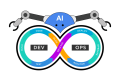
AI-Driven Deployment Orchestration & Auto-Rollback Training Course
AI-driven deployment orchestration is a method that leverages machine learning and automation to guide deployment strategies, detect anomalies, and initiate automatic rollback when necessary.
This instructor-led, live training (available online or on-site) is designed for intermediate-level professionals who aim to optimize deployment pipelines with AI-powered decision-making and resilience capabilities, specifically tailored for government applications.
Upon completion of this training, participants will be able to:
- Implement AI-assisted rollout strategies for safer deployments in public sector environments.
- Predict deployment risk using machine learning-driven insights to enhance governance and accountability.
- Integrate automated rollback workflows based on anomaly detection to ensure system integrity.
- Enhance observability to support intelligent orchestration for government operations.
Format of the Course
- Instructor-led demonstrations with technical deep dives, aligned with public sector workflows.
- Hands-on scenarios focused on deployment experimentation, tailored for government needs.
- Practical labs simulating real-world orchestration challenges specific to the public sector.
Course Customization Options
- Customized integrations, toolchain support, or workflow alignment for government-specific requirements can be arranged upon request.
Course Outline
Foundations of AI-Enhanced Deployment Workflows for Government
- How artificial intelligence (AI) enhances modern deployment practices in the public sector
- Overview of predictive deployment models tailored for government applications
- Key concepts: drift, anomaly signals, and rollback triggers for government systems
Building Intelligent Deployment Pipelines for Government
- Integrating AI components into existing continuous integration/continuous deployment (CI/CD) systems for government
- Data requirements for effective decision models in public sector workflows
- Pipeline instrumentation strategies to ensure compliance and transparency
Risk Prediction and Pre-Deployment Analysis for Government
- Evaluating release readiness with machine learning techniques for government applications
- Scoring models for deployment risk tailored to public sector needs
- Using historical data to inform smarter rollout planning in government systems
AI-Controlled Rollout Strategies for Government
- Automating blue/green and canary release selection for government deployments
- Dynamic adjustment of rollout speed to meet public sector requirements
- Real-time risk scoring during deployment to enhance government operations
Automated Rollback and Resilience Techniques for Government
- Understanding rollback triggers and thresholds in the context of government systems
- Detecting anomalies through metrics and logs for enhanced government oversight
- Coordinating rollbacks across distributed systems to ensure continuity in public sector operations
Observability for AI-Driven Orchestration for Government
- Collecting deployment telemetry to improve model accuracy for government applications
- Designing effective monitoring pipelines to support government compliance and accountability
- Correlating signals to enhance decision automation in public sector environments
Governance, Compliance, and Safety Controls for Government
- Ensuring auditability of AI-driven deployment actions in government systems
- Managing risk acceptance and approval policies to meet government standards
- Building trust mechanisms for automated decisions in public sector workflows
Scaling AI-Orchestrated Deployments for Government
- Architectures for multi-environment orchestration tailored to government needs
- Integrating edge, cloud, and hybrid deployments in the public sector
- Performance considerations for large-scale rollouts in government systems
Summary and Next Steps for Government
Requirements
- An understanding of CI/CD pipelines for government
- Experience with cloud-native deployment workflows for government operations
- Familiarity with containerization and microservices in a public sector context
Audience
- DevOps engineers supporting federal initiatives
- Release managers overseeing government projects
- Site reliability engineers (SREs) ensuring government system stability
Runs with a minimum of 4 + people. For 1-to-1 or private group training, request a quote.
AI-Driven Deployment Orchestration & Auto-Rollback Training Course - Booking
AI-Driven Deployment Orchestration & Auto-Rollback Training Course - Enquiry
AI-Driven Deployment Orchestration & Auto-Rollback - Consultancy Enquiry
Consultancy Enquiry
Upcoming Courses
Related Courses
AI for DevOps: Integrating Intelligence into CI/CD Pipelines
14 HoursAI for DevOps is the application of artificial intelligence to enhance continuous integration, testing, deployment, and delivery processes with intelligent automation and optimization techniques.
This instructor-led, live training (online or onsite) is designed for intermediate-level DevOps professionals who wish to integrate AI and machine learning into their CI/CD pipelines to improve speed, accuracy, and quality.
By the end of this training, participants will be able to:
- Integrate AI tools into CI/CD workflows for intelligent automation.
- Apply AI-based testing, code analysis, and change impact detection.
- Optimize build and deployment strategies using predictive insights.
- Implement traceability and continuous improvement using AI-enhanced feedback loops.
Format of the Course for Government
- Interactive lecture and discussion.
- Extensive exercises and practice sessions.
- Hands-on implementation in a live-lab environment.
Course Customization Options for Government
- To request a customized training for this course, please contact us to arrange.
AIOps Foundation – Accredited Training
14 HoursAIOps is a rapidly evolving field that addresses the needs of modern, complex IT environments, particularly those operating within cloud architectures. The AIOps Foundation course for government offers a comprehensive introduction to the concepts, technologies, and practices related to the use of artificial intelligence in IT operations.
This program covers the background of AIOps, its core principles, tools, and the organizational challenges faced by IT teams adopting these approaches.
The training concludes with an exam. Passing it grants the globally recognized AIOps Foundation certification for government, valid for three years.
Who is it for?
This course is designed for professionals and managers involved in:
IT operations
DevOps and Site Reliability Engineering (SRE)
Cloud architecture
Data analysis and Data Science
Software development
IT security
Product and project management
AIOps in Action: Incident Prediction and Root Cause Automation
14 HoursAIOps (Artificial Intelligence for IT Operations) is increasingly being utilized to predict incidents before they occur and automate root cause analysis (RCA) to minimize downtime and accelerate resolution.
This instructor-led, live training (online or onsite) is designed for advanced-level IT professionals who wish to implement predictive analytics, automate remediation processes, and design intelligent RCA workflows using AIOps tools and machine learning models for government applications.
By the end of this training, participants will be able to:
- Build and train machine learning models to detect patterns leading to system failures.
- Automate RCA workflows based on multi-source log and metric correlation.
- Integrate alerting and remediation processes into existing platforms.
- Deploy and scale intelligent AIOps pipelines in production environments for government use.
Format of the Course
- Interactive lecture and discussion.
- Extensive exercises and practice sessions.
- Hands-on implementation in a live-lab environment for government IT professionals.
Course Customization Options
- To request a customized training for this course, please contact us to arrange.
AIOps Fundamentals: Monitoring, Correlation, and Intelligent Alerting
14 HoursAIOps (Artificial Intelligence for IT Operations) is a practice that leverages machine learning and analytics to automate and enhance IT operations, particularly in the areas of monitoring, incident detection, and response.
This instructor-led, live training (online or onsite) is designed for intermediate-level IT operations professionals who aim to implement AIOps techniques to correlate metrics and logs, reduce alert noise, and improve observability through intelligent automation.
By the end of this training, participants will be able to:
- Understand the principles and architecture of AIOps platforms for government.
- Correlate data across logs, metrics, and traces to identify root causes.
- Reduce alert fatigue through intelligent filtering and noise suppression.
- Use open-source or commercial tools to monitor and respond to incidents automatically.
Format of the Course
- Interactive lecture and discussion.
- Extensive exercises and practice.
- Hands-on implementation in a live-lab environment.
Course Customization Options
- To request a customized training for this course, please contact us to arrange.
Building an AIOps Pipeline with Open Source Tools
14 HoursAn AIOps pipeline constructed entirely with open-source tools enables teams to develop cost-effective and flexible solutions for observability, anomaly detection, and intelligent alerting in production environments.
This instructor-led, live training (online or onsite) is designed for advanced-level engineers who wish to build and deploy an end-to-end AIOps pipeline using tools such as Prometheus, ELK, Grafana, and custom machine learning models. The training aims to enhance the skills necessary for government agencies to optimize their IT operations.
By the end of this training, participants will be able to:
- Design an AIOps architecture using only open-source components.
- Collect and normalize data from logs, metrics, and traces for government use.
- Apply machine learning models to detect anomalies and predict incidents.
- Automate alerting and remediation using open-source tooling.
Format of the Course
- Interactive lecture and discussion.
- Extensive exercises and practice sessions.
- Hands-on implementation in a live-lab environment.
Course Customization Options
- To request a customized training for this course, tailored specifically for government needs, please contact us to arrange.
AI-Powered QA Automation in CI/CD
14 HoursAI-powered quality assurance (QA) automation enhances traditional testing methods by generating intelligent test cases, optimizing regression coverage, and integrating advanced quality gates into continuous integration and deployment (CI/CD) pipelines. This ensures scalable and reliable software delivery for government.
This instructor-led, live training (available online or onsite) is designed for intermediate-level QA and DevOps professionals who wish to leverage AI tools to automate and scale quality assurance in continuous integration and deployment workflows.
By the end of this training, participants will be able to:
- Generate, prioritize, and maintain tests using AI-driven automation platforms.
- Integrate intelligent QA gates into CI/CD pipelines to prevent regressions.
- Use AI for exploratory testing, defect prediction, and test flakiness analysis.
- Optimize testing time and coverage across fast-moving agile projects.
Format of the Course
- Interactive lecture and discussion.
- Extensive exercises and practice sessions.
- Hands-on implementation in a live-lab environment.
Course Customization Options
- To request a customized training for government, please contact us to arrange.
Continuous Compliance with AI: Governance in CI/CD
14 HoursAI-supported compliance monitoring is a discipline that leverages intelligent automation to detect, enforce, and validate policy requirements throughout the software delivery lifecycle.
This instructor-led, live training (online or onsite) is designed for intermediate-level professionals who wish to integrate AI-driven compliance controls into their CI/CD pipelines for government operations.
Upon completing this training, participants will be equipped to:
- Utilize AI-based checks to identify compliance gaps during software builds.
- Employ intelligent policy engines to enforce regulatory, security, and licensing standards.
- Automatically detect configuration drift and deviations.
- Integrate real-time compliance reporting into delivery workflows.
Format of the Course
- Instructor-guided presentations supported by practical examples for government scenarios.
- Hands-on exercises focused on real-world CI/CD compliance challenges in the public sector.
- Applied experimentation within a controlled DevSecOps lab environment tailored for government use cases.
Course Customization Options
- If your organization requires customized compliance integrations specific to government requirements, please contact us to arrange.
GitHub Copilot for DevOps Automation and Productivity
14 HoursGitHub Copilot is an AI-powered coding assistant designed to automate various development tasks, including DevOps operations such as writing YAML configurations, GitHub Actions, and deployment scripts.
This instructor-led, live training (online or onsite) is aimed at professionals with beginner to intermediate levels of experience who wish to leverage GitHub Copilot to streamline DevOps tasks, enhance automation, and increase productivity for government projects.
By the end of this training, participants will be able to:
- Utilize GitHub Copilot to assist with shell scripting, configuration management, and CI/CD pipelines for government workflows.
- Leverage AI-driven code completion in YAML files and GitHub Actions to improve efficiency.
- Accelerate testing, deployment, and automation processes in public sector environments.
- Apply Copilot responsibly with an understanding of AI limitations and best practices for government use.
Format of the Course
- Interactive lecture and discussion sessions tailored to public sector needs.
- Extensive exercises and practice opportunities.
- Hands-on implementation in a live-lab environment, simulating real-world government scenarios.
Course Customization Options
- To request a customized training for this course specifically tailored to the needs of your government agency, please contact us to arrange.
DevSecOps with AI: Automating Security in the Pipeline
14 HoursDevSecOps with AI is the practice of integrating artificial intelligence into DevOps pipelines to proactively detect vulnerabilities, enforce security policies, and automate response actions throughout the software delivery lifecycle.
This instructor-led, live training (online or onsite) is aimed at intermediate-level DevOps and security professionals who wish to apply AI-based tools and practices to enhance security automation across development and deployment pipelines for government.
By the end of this training, participants will be able to:
- Embed AI-driven security tools into CI/CD pipelines.
- Use static and dynamic analysis powered by AI to detect issues earlier.
- Automate secrets detection, code vulnerability scanning, and dependency risk analysis.
- Enable proactive threat modeling and policy enforcement using intelligent techniques.
Format of the Course
- Interactive lecture and discussion.
- Extensive exercises and practice.
- Hands-on implementation in a live-lab environment.
Course Customization Options
- To request a customized training for this course, please contact us to arrange.
Enterprise AIOps with Splunk, Moogsoft, and Dynatrace
14 HoursEnterprise AIOps platforms such as Splunk, Moogsoft, and Dynatrace offer robust capabilities for detecting anomalies, correlating alerts, and automating responses across large-scale IT environments.
This instructor-led, live training (online or onsite) is designed for intermediate-level enterprise IT teams who wish to integrate AIOps tools into their existing observability stack and operational workflows for government.
By the end of this training, participants will be able to:
- Configure and integrate Splunk, Moogsoft, and Dynatrace into a cohesive AIOps architecture.
- Correlate metrics, logs, and events across distributed systems using AI-driven analysis.
- Automate incident detection, prioritization, and response with both built-in and custom workflows.
- Optimize performance, reduce mean time to resolution (MTTR), and enhance operational efficiency at enterprise scale.
Format of the Course
- Interactive lecture and discussion.
- Extensive exercises and practice sessions.
- Hands-on implementation in a live-lab environment.
Course Customization Options
- To request a customized training for this course, please contact us to arrange.
Implementing AIOps with Prometheus, Grafana, and ML
14 HoursPrometheus and Grafana are widely adopted tools for observability in modern infrastructure. These tools can be further enhanced with machine learning to provide predictive and intelligent insights, automating operations decisions.
This instructor-led, live training (online or onsite) is aimed at intermediate-level observability professionals who wish to modernize their monitoring infrastructure by integrating AIOps practices using Prometheus, Grafana, and machine learning techniques for government applications.
By the end of this training, participants will be able to:
- Configure Prometheus and Grafana for observability across systems and services in a public sector environment.
- Collect, store, and visualize high-quality time series data aligned with government workflows.
- Apply machine learning models for anomaly detection and forecasting to improve governance and accountability.
- Build intelligent alerting rules based on predictive insights to enhance operational efficiency.
Format of the Course
- Interactive lecture and discussion focused on government-specific use cases.
- Extensive exercises and practice sessions tailored for public sector professionals.
- Hands-on implementation in a live-lab environment designed to simulate real-world government scenarios.
Course Customization Options
- To request a customized training for this course, tailored specifically for government needs, please contact us to arrange.
LLMs and Agents in DevOps Workflows
14 HoursLarge language models (LLMs) and autonomous agent frameworks such as AutoGen and CrewAI are transforming how DevOps teams automate critical tasks like change tracking, test generation, and alert triage by simulating human-like collaboration and decision-making processes. These technologies enhance the efficiency and accuracy of public sector workflows, ensuring alignment with governance and accountability standards.
This instructor-led, live training (online or onsite) is designed for advanced-level engineers who wish to design and implement DevOps automation workflows powered by LLMs and multi-agent systems, specifically tailored for government applications.
By the end of this training, participants will be able to:
- Integrate LLM-based agents into CI/CD workflows to achieve intelligent automation for government processes.
- Automate test generation, commit analysis, and change summaries using agent technologies.
- Coordinate multiple agents for triaging alerts, generating responses, and providing DevOps recommendations in a secure and efficient manner.
- Build maintainable and secure agent-powered workflows using open-source frameworks that meet public sector standards.
Format of the Course
- Interactive lecture and discussion focused on government-specific use cases.
- Lots of exercises and practice to reinforce learning.
- Hands-on implementation in a live-lab environment, simulating real-world government scenarios.
Course Customization Options
- To request a customized training for this course, tailored specifically for government needs, please contact us to arrange.
LLM Engineering Bootcamp
35 HoursBy the end of this course, participants will be able to:
- Gain a comprehensive understanding of the architecture and operation of modern Large Language Models (LLMs).
- Create structured and robust technical prompts for styling, testing, refactoring, and automated quality assurance.
- Develop AI-aware wrappers and microservices that integrate seamlessly within enterprise development environments.
- Implement comprehensive Retrieval-Augmented Generation (RAG) pipelines to enhance organizational knowledge retrieval.
- Effectively manage security, privacy, and audit requirements for AI-driven code and data interactions, ensuring compliance with standards and best practices for government.
Predictive Build Optimization with Machine Learning
14 HoursPredictive build optimization is the practice of using machine learning to analyze build behavior and enhance reliability, speed, and resource utilization.
This instructor-led, live training (online or onsite) is designed for intermediate-level engineering professionals who wish to improve build pipelines through automation, prediction, and intelligent caching using machine learning techniques.
Upon completion of this course, attendees will be able to:
- Apply machine learning techniques to evaluate build performance patterns.
- Identify and forecast build failures based on historical build logs.
- Implement machine learning-driven caching strategies to decrease build times.
- Integrate predictive analytics into existing continuous integration/continuous deployment (CI/CD) workflows for government.
Format of the Course
- Instructor-guided lectures and collaborative discussions.
- Practical exercises focused on analyzing and modeling build data.
- Hands-on implementation within a simulated CI/CD environment.
Course Customization Options
- To tailor this training to specific toolchains or environments, please contact us to customize the program.