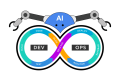
AI for DevOps: Integrating Intelligence into CI/CD Pipelines Training Course
AI for DevOps leverages artificial intelligence to optimize continuous integration, testing, deployment, and delivery through intelligent automation and advanced optimization methodologies.
This instructor-led training, available via online or onsite delivery, is designed for intermediate-level DevOps practitioners seeking to integrate machine learning and AI into their CI/CD pipelines to enhance operational velocity, precision, and quality.
Upon completion of this program, participants will be equipped to:
- Incorporate AI-driven tools into CI/CD workflows to enable intelligent automation.
- Utilize AI-based solutions for code analysis, testing, and change impact assessment.
- Refine build and deployment strategies through predictive analytics.
-
Establish traceability and drive continuous improvement via AI-enhanced feedback mechanisms.
Course Format
- Interactive lectures accompanied by strategic discussion.
- Extensive practical exercises and hands-on learning opportunities.
- Direct implementation within a live laboratory environment.
Course Customization for Government
- Agencies requiring tailored training solutions for this course should contact us to initiate arrangements.
Course Outline
Overview of Artificial Intelligence in DevOps Practices
- Definition and scope of artificial intelligence applications within DevOps frameworks
- Operational advantages and implementation scenarios for AI in continuous integration and delivery (CI/CD) workflows
- Assessment of platforms and tools facilitating AI-driven automation for government systems
Support for Code Development and Review via AI
- Application of tools such as GitHub Copilot to enhance code completion efficiency
- Implementation of automated quality assurance and remediation suggestions
- Automation of test generation and identification of potential security vulnerabilities
Optimization of CI/CD Pipeline Architecture
- Configuration of Jenkins and GitHub Actions with AI-enhanced workflow steps
- Utilization of predictive analytics for build initiation and intelligent rollback mechanisms
- Adaptive pipeline modifications informed by historical performance data
Automation of Testing Processes through AI
- Deployment of AI-driven test creation and prioritization systems (e.g., Testim, mabl) for federal operations
- Application of machine learning algorithms for regression test analysis
- Mitigation of test instability and reduction of execution time using data-driven insights
AI-Enhanced Static and Dynamic Code Analysis
- Integration of SonarQube and comparable tools into development pipelines
- Automated identification of code inefficiencies and provision of refactoring guidance
- Comprehensive impact analysis and risk profiling of codebases
Monitoring, Feedback Loops, and Continuous Improvement
- Utilization of AI-enabled observability platforms for anomaly detection
- Application of machine learning models to evaluate deployment outcomes
- Establishment of automated feedback mechanisms across the software development lifecycle (SDLC)
Case Studies and Implementation Strategies
- Analysis of AI-enhanced CI/CD deployments in large-scale enterprise environments
- Integration protocols for cloud-native platforms and microservices architectures
- Identification of implementation challenges, recommended strategies, and established best practices
Summary and Strategic Next Steps
Requirements
- Demonstrated proficiency in DevOps methodologies and continuous integration/continuous deployment (CI/CD) pipelines.
- Foundational knowledge of version control systems and automation utilities.
- Working understanding of software quality assurance and deployment processes.
Intended Audience
- DevOps practitioners and infrastructure platform teams.
- Leaders of QA automation initiatives and testing engineers.
- Software architects and release management personnel.
Runs with a minimum of 4 + people. For 1-to-1 or private group training, request a quote.
AI for DevOps: Integrating Intelligence into CI/CD Pipelines Training Course - Booking
AI for DevOps: Integrating Intelligence into CI/CD Pipelines Training Course - Enquiry
AI for DevOps: Integrating Intelligence into CI/CD Pipelines - Consultancy Enquiry
Upcoming Courses
Related Courses
AI-Driven Deployment Orchestration & Auto-Rollback
14 HoursAutomated deployment orchestration leveraging artificial intelligence utilizes machine learning algorithms to direct release protocols, identify irregularities, and initiate automatic remediation procedures when necessary.
This instructor-led program, available via online or in-person delivery, targets intermediate-level practitioners seeking to enhance deployment pipelines through AI-enabled decision support and resilience mechanisms. Designed for government contexts, this course ensures operational continuity and security compliance.
Upon successful completion of this training, participants will be equipped to:
- Deploy AI-assisted release strategies to improve deployment safety and integrity.
- Anticipate deployment risks through machine learning–based analytical insights.
- Establish automated rollback procedures triggered by anomaly detection systems.
- Improve system observability to facilitate intelligent orchestration processes.
Course Format
- Instructor-led technical demonstrations and detailed analysis.
- Practical exercises centered on deployment experimentation.
- Interactive labs that replicate complex orchestration scenarios.
Customization Options
- Tailored integrations, toolchain compatibility, and workflow alignment are available upon request to meet specific agency requirements.
AI for Feature Flag & Canary Testing Strategy
14 HoursAI-driven rollout control leverages machine learning, pattern analysis, and adaptive decision models to manage feature flag operations and canary testing workflows.
This instructor-led, live training (online or onsite) targets intermediate-level engineers and technical leads seeking to enhance release reliability and optimize feature exposure decisions using AI-driven analysis, specifically designed for government agencies.
Upon completion of this course, participants will be able to:
- Apply AI-based decision models to assess the risk of new feature exposure.
- Automate canary analysis using performance, behavioral, and operational indicators.
- Integrate intelligent scoring systems into feature flag platforms.
- Design rollout strategies that dynamically adjust based on real-time data.
Format of the Course
- Guided discussions supported by real-world scenarios.
- Hands-on exercises emphasizing AI-enhanced rollout strategies.
- Practical implementation in a simulated feature flag and canary environment.
Course Customization Options
- To arrange tailored content or integrate organization-specific tooling, please contact us.
AI-Driven Observability: From Logs to LLM-Powered Insights
14 HoursThis instructor-led, live training session delivered in US (virtual or on-site) is designed for observability and Site Reliability Engineering professionals seeking to incorporate large language models and artificial intelligence into their monitoring, alerting, and incident resolution processes. The curriculum supports the development of specialized competencies for government practitioners who require advanced tools for system resilience and operational efficiency.
AIOps Foundation – Accredited Training
35 HoursAIOps represents a dynamic discipline addressing the requirements of contemporary, intricate IT infrastructures, specifically those deployed within cloud environments. The AIOps Foundation course provides an exhaustive overview of the underlying concepts, technical frameworks, and operational practices associated with integrating artificial intelligence into IT operations management. This curriculum is designed to support government entities seeking specialized training for government personnel in this emerging sector.
The instructional program encompasses the historical context of AIOps, fundamental principles, available tools, and the organizational obstacles encountered by IT teams during implementation.
Upon completion of the training, participants must pass an assessment to earn the internationally recognized AIOps Foundation certification, which remains valid for a period of three years.
Target Audience
This educational offering is intended for professionals and managerial staff engaged in the following areas:
IT operations
DevOps and Site Reliability Engineering (SRE)
Cloud architecture
Data analysis and Data Science
Software development
IT security
Product and project management
AIOps in Action: Incident Prediction and Root Cause Automation
14 HoursArtificial Intelligence for IT Operations (AIOps) solutions are increasingly deployed to anticipate system events prior to occurrence and to automate root cause analysis (RCA), thereby reducing operational downtime and expediting resolution efforts.
This instructor-led live training, available in online or onsite formats, targets advanced IT professionals seeking to implement predictive analytics, automate remediation procedures, and design intelligent RCA workflows using AIOps tools and machine learning models tailored for government.
Upon completion of this training, participants will be capable of:
- Constructing and training machine learning models to identify patterns indicative of system failures.
- Automating root cause analysis workflows through the correlation of multi-source logs and metrics.
- Integrating alerting and remediation processes into existing enterprise platforms.
- Deploying and scaling intelligent AIOps pipelines within production environments.
Course Format
- Interactive lectures and discussion sessions.
- Extensive exercises and practical application.
- Hands-on implementation within a live laboratory environment.
Course Customization Options
- To request customized training for this course, please contact the program administrators to arrange accommodations.
AIOps Advanced
21 HoursThe AI Ops Advanced curriculum builds upon core AIOps concepts to deliver practical, experiential learning using real-world tools, advanced machine learning methodologies, automation workflows, and operational design patterns. The program equips participants with the capabilities to construct, configure, optimize, and extend AIOps pipelines and integration frameworks, ensuring alignment with public sector requirements for government.
This instructor-led, live training session (available online or onsite) targets intermediate to advanced IT professionals seeking to design and implement resilient AIOps ecosystems, conduct advanced analytics, and automate operational workflows using industry-standard tools.
Upon completion of this training, participants will be capable of:
- Correlating and normalizing diverse operational data sources.
- Designing and tuning anomaly detection and root cause analysis models.
- Integrating AIOps solutions with ITSM and DevOps pipelines.
- Developing closed-loop automation and predictive incident workflows.
Format of the Course
- Advanced lectures and architecture discussions.
- Hands-on labs with industry tools and platforms.
- Case studies and optimization exercises.
AIOps Foundation
14 HoursAIOps, or Artificial Intelligence for IT Operations, leverages machine learning, advanced analytics, and automation to optimize and strengthen IT service management. This approach enables agencies to automate incident detection, correlate disparate events, and enhance the quality of operational decision-making.
This guided instruction, available online or at agency facilities, is designed for entry-level information technology staff seeking to master the foundational principles of integrating AI and big data into IT operations. The curriculum focuses on improving observability, performance metrics, and incident response capabilities.
To support federal workforce development and digital transformation initiatives for government, this training provides essential knowledge for modernizing IT infrastructure.
Upon successful completion of this course, participants will be able to:
- Analyze the historical development and strategic significance of AIOps.
- Detail the role of big data and machine learning technologies within AIOps frameworks.
- Recognize critical operational metrics and applicable use cases for AIOps implementation.
- Evaluate organizational impacts, deployment strategies, and associated challenges.
Course Structure
- Engaging lectures and facilitated discussions.
- Analysis of case studies and scenario-based dialogue.
- Practical exercises utilizing AIOps concepts and tools.
AIOps Fundamentals: Monitoring, Correlation, and Intelligent Alerting
14 HoursArtificial Intelligence for IT Operations (AIOps) leverages machine learning and advanced analytics to automate and enhance information technology workflows, specifically within monitoring, incident detection, and response capabilities.
This instructor-led training program, available online or onsite, is designed for intermediate-level IT operations personnel seeking to apply AIOps methodologies. Participants will learn to correlate metrics and logs, mitigate alert fatigue, and enhance system observability through intelligent automation, ensuring alignment with public sector standards for government infrastructure.
Upon completion of this course, participants will be equipped to:
- Comprehend the foundational principles and architectural framework of AIOps platforms.
- Correlate data derived from logs, metrics, and traces to identify root causes of system issues.
- Decrease alert fatigue by implementing intelligent filtering and noise suppression techniques.
- Utilize open-source or commercial tools to automate monitoring and incident response procedures.
Course Format
- Interactive lectures and structured discussions.
- Comprehensive exercises and practical applications.
- Hands-on implementation within a live laboratory environment.
Customization Options
- For agencies requiring tailored curriculum development, please contact our team to coordinate arrangements.
Building an AIOps Pipeline with Open Source Tools
14 HoursOrganizations leveraging exclusively open-source technologies can construct scalable and economical pipelines for AIOps, enabling robust observability, anomaly detection, and intelligent alerting within production infrastructure.
This instructor-led session, delivered either online or onsite, is designed for advanced engineering professionals seeking to implement a comprehensive AIOps pipeline utilizing Prometheus, ELK, Grafana, and proprietary machine learning models. These capabilities are particularly valuable for government agencies requiring secure and adaptable solutions for government operations.
Upon completion of this training, participants will demonstrate proficiency in:
- Architecting AIOps systems using exclusively open-source components.
- Aggregating and standardizing data derived from logs, metrics, and traces.
- Deploying machine learning algorithms to identify anomalies and forecast system incidents.
- Executing automated alerting and remediation workflows through open-source tooling.
Course Structure
- Interactive instruction and technical discussion.
- Comprehensive practical exercises and scenario-based learning.
- Direct implementation activities within a live laboratory environment.
Customization Opportunities
- Agencies seeking tailored training for this subject matter are encouraged to contact the administration to arrange specific requirements.
AI-Powered Test Generation and Coverage Prediction
14 HoursAI-enabled test generation encompasses methodologies and instruments that automate the development of test cases and identify coverage deficiencies through machine learning algorithms.
This instructor-led training program, available in virtual or on-site formats, is designed for senior professionals seeking to implement artificial intelligence techniques for automated test creation and predictive gap analysis. It provides a framework for government agencies to enhance their quality assurance processes.
Upon completion of this workshop, participants will be equipped to:
- Utilize AI models to construct robust unit, integration, and end-to-end test scenarios.
- Apply machine learning algorithms to evaluate codebases and identify potential coverage vulnerabilities.
- Embed AI-driven test generation capabilities into continuous integration and delivery (CI/CD) pipelines.
- Refine testing strategies by leveraging predictive failure analytics.
Course Format
- Technical instruction guided by subject matter experts.
- Practical exercises and scenario-based learning activities.
- Experimental application within a secure, controlled testing environment.
Customization Options
- Organizations requiring alignment with specific enterprise toolchains or operational workflows may contact the training provider to arrange customized sessions.
Autonomous Operations with AI Agents
14 HoursThis hands-on instructional program, conducted US via virtual or in-person delivery, serves Site Reliability Engineering and DevOps practitioners seeking to architect, construct, and securely implement artificial intelligence-driven agents for automated information technology environments tailored for government applications.
Enterprise AIOps with Splunk, Moogsoft, and Dynatrace
14 HoursEnterprise-grade AIOps solutions, including Splunk, Moogsoft, and Dynatrace, deliver robust functionalities for identifying anomalies, correlating alerts, and automating responses within extensive IT infrastructures.
This instructor-led training program, available via online or onsite delivery, is designed for intermediate-level enterprise IT personnel seeking to incorporate AIOps tools into their existing observability frameworks and operational procedures.
Upon completion of this instruction, participants will be equipped to:
- Configure and integrate Splunk, Moogsoft, and Dynatrace into a cohesive AIOps architecture.
- Correlate metrics, logs, and events across distributed systems utilizing AI-driven analysis.
- Automate incident detection, prioritization, and response through built-in and custom workflows.
- Enhance performance, reduce mean time to resolution (MTTR), and improve operational efficiency at enterprise scale for government entities.
Course Format
- Interactive lectures and discussions.
- Extensive exercises and practical application.
- Hands-on implementation within a live laboratory environment.
Customization Options
- To arrange customized training for this course, please contact us.
Implementing AIOps with Prometheus, Grafana, and ML
14 HoursPrometheus and Grafana serve as foundational tools for infrastructure observability, while the integration of machine learning introduces predictive capabilities and intelligent analytics to streamline operational decision-making processes.
This instructor-led training program, available via online or onsite delivery, is designed for intermediate-level professionals seeking to modernize monitoring frameworks by incorporating AIOps methodologies using Prometheus, Grafana, and machine learning techniques specifically for government applications.
Upon completion of this curriculum, participants will demonstrate the ability to:
- Configure Prometheus and Grafana to support comprehensive observability across diverse systems and services.
- Acquire, retain, and visualize high-fidelity time-series data streams.
- Deploy machine learning models for the purposes of anomaly detection and predictive forecasting.
- Establish intelligent alerting protocols grounded in predictive analytics.
Course Delivery Format
- Engaging lectures coupled with interactive discussions.
- Extensive practical exercises and skill-building activities.
- Practical application within a live laboratory environment.
Customization Opportunities
- To arrange tailored training services for this course, please contact us to coordinate requirements.
LLMOps: Production LLM Operations and Governance
14 HoursThis instructor-led, live course, available via US (online or onsite), targets ML engineers and platform teams seeking to develop scalable, resilient operational pipelines for large language model-based applications.
ML Security and AI Red Teaming
14 HoursUS This instructor-led, live training session (available online or onsite) is designed for security and machine learning engineers seeking to identify, test, and mitigate attacks targeting ML models and LLM-powered applications. Tailored specifically for government professionals, the course emphasizes actionable defense strategies aligned with public sector operational needs.