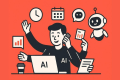
Introduction to AI for Administrative Operations Training Course
Artificial Intelligence (AI) constitutes a discipline within computer science dedicated to the development of systems capable of executing functions that traditionally necessitate human cognitive abilities. These functions encompass learning, logical reasoning, complex problem-solving, sensory perception, natural language comprehension, and related capabilities.
This instructor-led training session, available in online or onsite formats, targets entry-level administrative personnel seeking foundational knowledge regarding AI principles and their utility in streamlining administrative workflows. The curriculum is designed to support government entities by delivering practical insights for public sector applications.
Upon completion of this program, participants will be able to:
- Comprehend the fundamental concepts of Artificial Intelligence (AI).
- Identify methods for integrating AI solutions into routine administrative operations.
- Enhance operational efficiency in email correspondence, survey administration, metric monitoring, recordkeeping, and manual verification processes through the use of AI technologies for government initiatives.
Course Delivery Methodology
- Interactive lectures and structured discussions.
- Extensive practical exercises and application activities.
- Direct implementation within a live laboratory environment.
Program Customization Availability
- For organizations requiring tailored training modules, please contact the administration to coordinate scheduling and content specifications.
Course Outline
Introduction
- Concise summary of artificial intelligence and its role in contemporary federal operations.
Fundamentals of Artificial Intelligence
- Definition and historical context of AI technologies.
- Core principles: Machine Learning, Natural Language Processing, and Process Automation.
- Illustrative examples of AI implementations across various sectors relevant to public service for government entities.
AI Integration in Administrative Workflows
- Streamlining communication through AI-driven email management
- Overview of platforms and tools facilitating automated correspondence.
- Guidelines for crafting effective, standardized automated communications.
- Utilizing AI for survey administration
- Methods for designing surveys and interpreting analytical data.
- Software solutions supporting automated deployment and response evaluation for government initiatives.
- Leveraging AI for performance measurement
- Strategies for identifying critical performance indicators (KPIs).
- Digital tools enabling automated data collection and reporting.
Practical Application: AI Software Ecosystem
- Guided demonstration of widely adopted AI applications
- Email automation solutions (e.g., Mailchimp, Microsoft Outlook intelligent features).
- Data collection platforms (e.g., SurveyMonkey, Google Forms with AI analytics).
- Business intelligence and tracking utilities (e.g., Tableau, Power BI).
- Interactive exercises allowing participants to practice using selected AI tools.
Data Stewardship: Automated Records and Validation
- Efficiencies in record keeping via automation
- Introduction to AI-enhanced document management systems.
- Solutions for digital archiving and automated filing procedures compliant with government standards.
- Improving data integrity through validation
- AI-assisted mechanisms for data verification and error detection.
- Case studies and tool demonstrations illustrating best practices.
Conclusion and Future Directions
Requirements
- Foundational competency in computer operations, encompassing operating system navigation
- Prior experience executing routine administrative duties
Audience
- Administrative personnel responsible for governmental operations
Runs with a minimum of 4 + people. For 1-to-1 or private group training, request a quote.
Introduction to AI for Administrative Operations Training Course - Booking
Introduction to AI for Administrative Operations Training Course - Enquiry
Introduction to AI for Administrative Operations - Consultancy Enquiry
Testimonials (1)
The trainer is patient and very helpful. He knows the topic well.
CLIFFORD TABARES - Universal Leaf Philippines, Inc.
Course - Agentic AI for Business Automation: Use Cases & Integration
Upcoming Courses
Related Courses
Advanced AI for Strategic Communications
7 HoursBuilding upon the foundational instruction in Generative AI principles, this intensive one-day workshop serves as an advanced deep-dive for the Corporate Communications staff. The central goal is to transition from theoretical concepts to practical application by empowering participants with the technical capabilities to strategically design and deploy AI-driven solutions that address specific departmental requirements. This hands-on, project-centric curriculum concludes with a collaborative competition intended to stimulate innovation and produce operational AI workflows customized for stakeholder communication priorities.
Upon completion of this instruction, participants will be able to:
- Apply sophisticated prompt engineering methodologies to execute complex and nuanced communication assignments.
- Architect and conceptualize specialized AI agents or Custom GPTs to streamline recurring operational processes.
- Utilize artificial intelligence instruments to perform comprehensive analyses of campaign efficacy, media sentiment, and audience engagement data.
- Work collaboratively to formulate a strategic, actionable AI-powered solution addressing authentic departmental challenges.
- Present an AI-driven initiative with clarity, effectively articulating its organizational value and business impact for government operations.
Agentic AI for Business Automation: Use Cases & Integration
21 HoursThis instructional module on Agentic AI for Business Automation provides practical guidance on the design, integration, and expansion of artificial intelligence agents within operational workflows. The curriculum emphasizes the identification of automation opportunities, the coordination of technical tools, and the development of functional applications across sectors such as customer support, logistics, and marketing.
Facilitated by subject matter experts through live online or on-site sessions, this training targets mid-career professionals seeking to deploy AI-enabled automation utilizing no-code, low-code, and Python-based methodologies. The program is specifically tailored for government entities requiring robust digital transformation strategies.
Upon completion of the course, participants will possess the capability to:
- Pinpoint critical operational areas where agentic AI enhances efficiency and fosters innovation.
- Evaluate and map workflows for optimal AI agent integration.
- Deploy automation solutions utilizing application programming interfaces (APIs) and orchestration platforms.
- Align AI model deployment with enterprise objectives to achieve quantifiable results.
- Establish governance frameworks and monitoring protocols for sustainable AI operations.
Training Methodology
- Interactive instruction combined with technical demonstrations.
- Practical exercises supported by guided project development.
- Real-time application within a sandbox automation environment.
Customization Opportunities
- Agencies seeking specialized training content should contact the provider to coordinate customized arrangements.
AI as an Agile Pilot
7 HoursThis facilitated instruction, offered via US in either virtual or physical formats, targets professionals at beginner, intermediate, and advanced proficiency levels who seek to apply Artificial Intelligence within Project Management and Agile frameworks. The objective is to transition from manual coordination processes to data-driven orchestration. This curriculum addresses traditional bottlenecks in the software development lifecycle (SDLC) by utilizing Machine Learning and Large Language Models. Through the application of AI to functions such as GitOps, capacity planning, and requirements engineering, agencies can improve forecasting accuracy and decrease administrative workload. This approach enables personnel to concentrate on high-value strategic initiatives while automated systems manage data processing complexity and scenario analysis for government operations.
Upon completion of this course, attendees will be equipped to:
- Comprehend the technical principles underlying Transformers, Large Language Models (LLMs), and Small Language Models (SLMs).
- Assess AI solutions regarding cost efficiency, latency, data privacy standards, and vendor lock-in risks.
- Employ advanced prompt engineering and Retrieval-Augmented Generation (RAG) methodologies for professional applications.
- Incorporate AI capabilities throughout the Agile lifecycle, encompassing ideation, backlog refinement, and risk management.
- Recognize and mitigate risks associated with AI ethics, algorithmic bias, hallucinations, and model degradation.
- Utilize model-based problem-solving techniques to address complex engineering and management challenges.
AI-Enhanced Architect Workflow
7 HoursThis instructor-led, live training session US (online or onsite) is designed for beginner-level / intermediate-level / advanced-level professionals seeking to modernize traditional architectural workflows into AI-native processes. Rather than supplanting creative expertise, the curriculum emphasizes augmentation—leveraging Artificial Intelligence to automate routine tasks, expedite conceptual development, and reduce administrative overhead. The workshop facilitates the transition from preliminary sketches to polished, professional-grade presentations.
Upon completion of this training, participants will be equipped to:
- Rapidly produce 3-5 conceptual design variants in the timeframe previously required for a single concept.
- Execute advanced post-production on renderings independently, thereby reducing reliance on external vendors for minor adjustments.
- Apply Multimodal AI tools (Gemini/GPT) to evaluate complex building codes and technical documentation with precision.
- Deploy automated administrative workflows to reclaim valuable hours of manual labor each week.
Artificial Intelligence (AI) for Corporate Professionals
14 HoursThe Artificial Intelligence (AI) for Corporate Professionals program provides an foundational overview of how AI technologies can be securely and efficiently integrated across organizational units to enhance operational output, strengthen interpersonal exchange, and optimize business processes.
This instructor-led session, available in both virtual and on-site modalities, targets non-technical personnel seeking to comprehend and implement AI platforms such as ChatGPT, Gemini, and Copilot to refine daily job functions. The curriculum is designed with the specific needs of government sectors in mind, ensuring relevant application for for government agencies and public sector entities.
Upon completion of this training, participants will be capable of:
- Identifying core AI principles, potential liabilities, and ethical frameworks.
- Utilizing AI systems to automate procedural tasks and support information retrieval and correspondence.
- Developing precise prompts aligned with practical administrative requirements.
- Formulating strategies for the secure and scalable deployment of AI solutions within their teams.
Course Structure
- Collaborative lectures and policy-related discussions.
- Practical application of AI tools within organizational contexts.
- Supervised exercises emphasizing process efficiency and effective communication.
Program Adaptability
- To arrange customized instruction tailored to specific departmental workflows or proprietary systems, please contact our administrative office.
AI for Daily Tasks: Enhancing Efficiency Across Departments
14 HoursThis instructor-led, live training delivered in US (via online platform or in-person) is designed for early-to-mid-career professionals across various branches seeking to effectively utilize AI applications for routine duties, thereby conserving resources and enhancing operational output.
Upon completion of this instruction, attendees will be capable of:
- Selecting appropriate AI-enabled instruments for specific assignments.
- Implementing automation for recurring procedures to optimize workflow efficiency.
- Utilizing artificial intelligence to enhance correspondence, documentation, and analytical judgments.
- Maintaining responsible and ethical standards in the deployment of AI technologies within the workplace.
Strategic AI Implementation for Operational Excellence
14 HoursThe Strategic Artificial Intelligence Implementation for Operational Excellence initiative advances your personnel beyond fundamental chatbot functions by addressing sophisticated prompt engineering, enterprise-level data security protocols, and department-specific automation within Legal, Procurement, and Quality Management operations. Participants will navigate through automated contract analysis, vendor evaluation frameworks, standard operating procedure generation tools, and structured prompting methodologies designed for the processing of complex corporate documentation. This program provides Legal, Procurement, and Quality Management divisions with validated strategies for embedding large language models into routine activities, transforming generic AI capabilities into specialized assets that enhance document review efficiency, streamline procurement processes, and ensure adherence to quality standards in professional settings for government.
AI Literacy & Productivity
7 HoursIn the current Financial Services Industry (FSI) landscape, leveraging artificial intelligence for productivity is essential to maintain operational competitiveness. This curriculum is designed to foster organization-wide AI proficiency, providing personnel in claims, underwriting, actuarial science, strategic planning, and operations with safe, standardized methodologies for prompt engineering and process automation. These resources are developed specifically for government applications.
Program Structure
- Interactive presentations and policy discussions.
- Extensive practical exercises and skill-building activities.
- Practical application within a live laboratory environment.
Customization Opportunities
- To arrange customized training for this course, please contact the program administrators.
Building AI Workflows in n8n
14 HoursThis instructor-led, live training provided in US (via online or onsite formats) is designed for intermediate to advanced developers and artificial intelligence practitioners seeking to develop sophisticated AI workflows within the n8n platform. These sessions are tailored for government audiences who require secure and efficient automation solutions.
Upon completion of this course, participants will be capable of:
- Understanding the integration of artificial intelligence services with n8n workflows.
- Implementing AI-driven decision-making within automated processes.
- Creating custom AI nodes and utilizing pre-built AI components in n8n.
- Analyzing and optimizing the performance of artificial intelligence workflows.
AI for Productivity and Safe Use in the Workplace
7 HoursThe adoption of Artificial Intelligence (AI) is reshaping operational methodologies across the public sector by automating routine processes and strengthening collaborative decision-making frameworks. Solutions such as ChatGPT and Microsoft Copilot support personnel in content creation, data analysis, and communication efficiency; however their deployment requires strict adherence to established protocols regarding data privacy, security, and ethical standards.
This instructor-led training program, available in online or onsite formats for government audiences, targets entry-level professionals and managers seeking foundational knowledge of AI principles. The curriculum focuses on the safe and effective integration of AI technologies into daily workflows to ensure alignment with organizational governance.
Upon completion of this course, participants will be able to:
- Demonstrate comprehension of core AI concepts and their application within agency operations.
- Leverage ChatGPT and Copilot to enhance workflow productivity and inter-team collaboration.
- Deploy AI resources responsibly while maintaining compliance with data privacy requirements and ethical norms.
- Identify specific functions suitable for automation through artificial intelligence.
Course Format
- Synchronous instruction featuring interactive lectures and policy discussions.
- Practical exercises grounded in real-world administrative scenarios.
- Supervised practice utilizing ChatGPT, Copilot, and automation prompts.
Course Customization Options
- To request a customized training for this course, please contact us to arrange.
AI Strategy for Managers: Fundamentals, Use Cases and an Implementation Roadmap
16 HoursThis instructor-led, live training in US (online or on-site) is designed for senior managers and department heads who seek to establish the strategic knowledge and roadmap required to initiate AI integration within their teams and operational areas.
AI for Technical Support and Automated Documentation
16 HoursThis guided, interactive training session in US (accessible remotely or in person) targets information technology support staff seeking to leverage artificial intelligence utilities and automation systems to optimize service workflows, ensure consistent resolution protocols, and minimize the burden of administrative record-keeping for government operations.
Introduction to Artificial Intelligence (AI) for Workplace Productivity
7 HoursArtificial Intelligence (AI) constitutes a dynamic discipline offering systems and instruments capable of automating operations, processing data, and optimizing decision-making processes across organizational functions.
This instructor-led, live training session (available online or at a designated site) is designed for non-technical personnel seeking to comprehend the fundamentals of AI, its operational mechanisms, and its potential to enhance departmental productivity within a corporate environment. The curriculum is tailored for government audiences and other public sector entities requiring strategic oversight.
Upon completion of this training, participants will be able to:
- Grasp the fundamental principles and capabilities associated with AI.
- Recognize the impact of AI on diverse business sectors.
- Identify appropriate AI instruments to support daily operational workflows.
- Implement basic AI-driven procedures to improve efficiency and decision quality.
Course Format
- Interactive lectures and group discussions.
- Practical demonstrations of AI applications.
- Scenario-based exercises and analysis of use cases.
Customization Options
- To request customized training for this course, please contact us to arrange services.
Canva and AI in practice
14 HoursCourse Objectives
Core Functionality Overview
Attendees will acquire proficiency in Canva’s essential utilities, including text formatting and media integration. This foundational knowledge supports the creation of professional-grade visual communications required for government operations.
Project Execution
Through practical application, participants will construct their initial design by selecting appropriate templates, customizing typographic elements, and applying specific color schemes. This exercise ensures alignment with standardized branding protocols for government entities.
Advanced Methodologies
Learners will investigate sophisticated capabilities to produce complex deliverables, such as data visualizations, process diagrams, and refined photographic assets. These techniques enhance the clarity and impact of official documents for government audiences.
Intelligent Automation
The curriculum covers the integration of artificial intelligence features to streamline workflows, automate content generation, and optimize productivity. Implementing these tools allows staff to maintain high-quality standards while meeting operational demands for government initiatives.
ChatGPT and Microsoft 365 Copilot for Advanced Productivity
15 HoursChatGPT and Microsoft 365 Copilot are artificial intelligence solutions engineered to optimize productivity and organizational communication via automated processes, intelligent content synthesis, and workflow efficiency improvements. These tools are designed for government operations to support modernized service delivery.
This instructor-led training program, available in live online or on-site formats, is intended for intermediate-level personnel seeking to integrate ChatGPT and Microsoft 365 Copilot capabilities. The curriculum focuses on automating document generation, enhancing professional correspondence, and supporting data-informed decision-making processes.
Upon completion of this training, participants will be able to:
- Utilize ChatGPT to automate the drafting of documents, summarize information, and facilitate idea development.
- Implement advanced prompting methodologies to ensure high-quality artificial intelligence outputs.
- Apply Microsoft 365 Copilot within Excel, PowerPoint, and Outlook to analyze datasets and streamline communication channels.
- Incorporate Copilot into enterprise systems to facilitate collaboration and automate operational procedures.
Course Delivery Format
- Interactive instruction combined with technical demonstrations.
- Practical exercises utilizing real-world agency case studies.
- Direct application within the Microsoft 365 environment.
Training Customization Options
- To request a tailored training session for this course, please contact the program administrators to arrange details.